

For many aspiring homeowners, trying to save enough money to cover the down payment and closing costs is their biggest hurdle to homeownership. It may feel like an overwhelming task, a goal that takes a considerable amount of time and effort to accomplish.
It isn't surprising, considering that the national median home price as of the last quarter of 2025 was a record high of $365,000, according to real estate data provider ATTOM. If you are working towards putting the conventional 20 percent down payment, that would easily equate to $73,000.
Even if you’re not putting 20 percent down, we’re still talking about saving thousands of dollars. This is why it’s also crucial to know your options on where to keep your funds while working toward this huge financial accomplishment. You’d want to keep your cash somewhere relatively accessible, but also earn a competitive interest rate so your savings can grow at the fastest rate possible.
If you’re a prospective buyer who’s trying to figure out the best places to store your money when you’re saving for a down payment on a mortgage, we explore some great options you may want to consider.
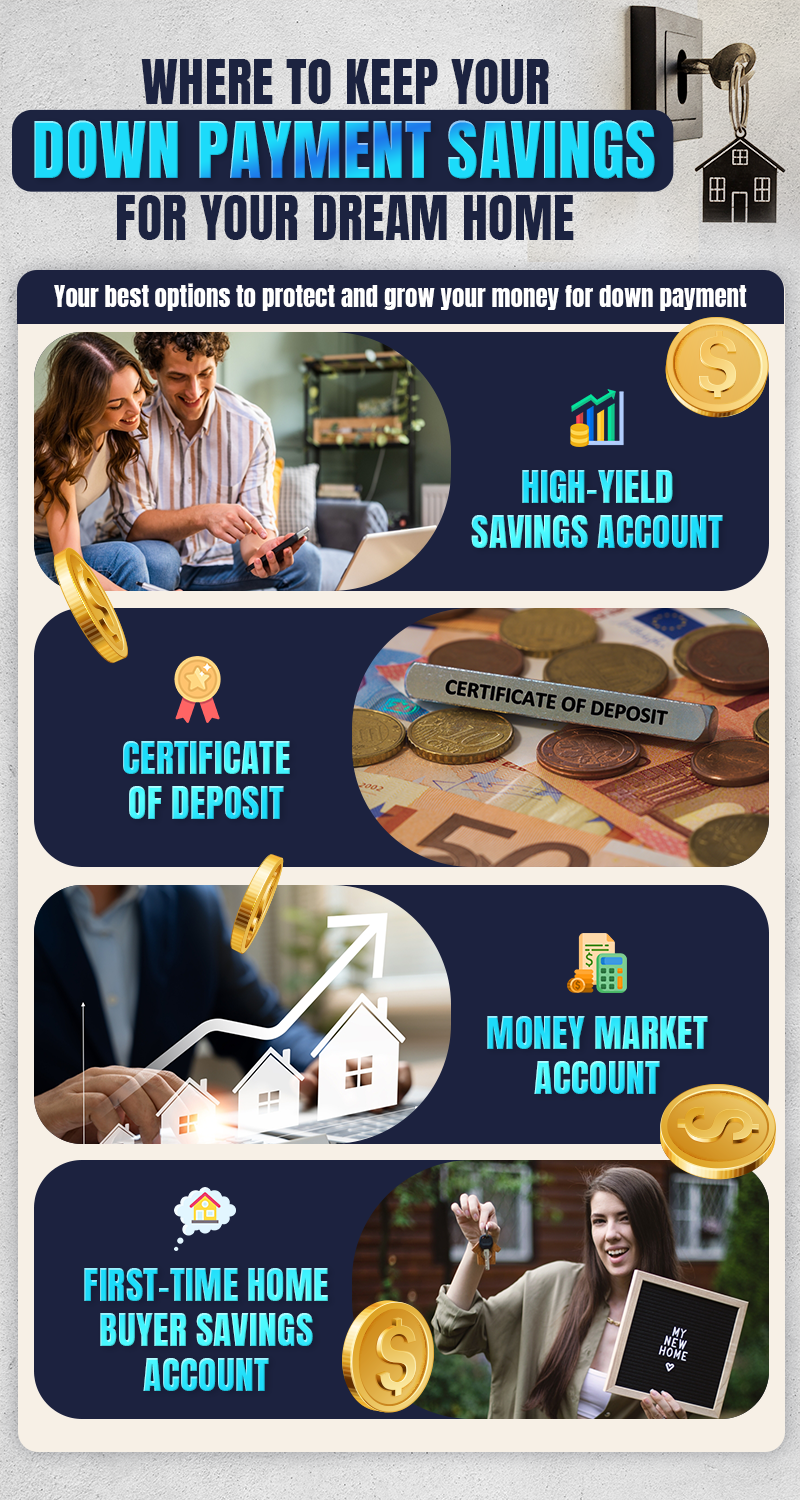
High-yield savings account
Best for: Buyers who want to take advantage of competitive interest rates and flexibility to withdraw their money anytime they need it to make a down payment.
Possible downside/s:
Your money remains easily accessible, which could lead to temptation to use it for other purposes.
The annual percentage yield (APY) on HYSAs is variable instead of fixed, which means the rate can fluctuate at any time with Federal Reserve decisions.
If you love the convenience and customer service of a brick-and-mortar establishment, you might struggle with this setup since most of these types of accounts are offered by online-only banks.
A high-yield savings account (HYSA) is one of your best options if you want to save money for a down payment on a home. This is a type of savings account that earns its name by offering a higher APY compared to standard savings accounts. Some of the best online banks and credit unions offer HYSAs with interest rates over 10 times higher than the national average.
If you need to access your money early for a down payment or a deposit, HYSAs also offer you the flexibility to withdraw from your savings at any time without penalty, although some financial institutions may limit the number of withdrawals you can make per month. If you're planning to buy a home within 6 to 12 months, a high-yield savings account is your best bet. It’s an easy way to add a bit extra to your house savings fund compared to having a regular savings account.
Certificate of Deposit
Best for: Buyers who want to lock in today's higher interest rates but are still far out from purchasing a home.
Possible downside/s:
Your money is less accessible, so if you withdraw from your account before your certificate of deposit matures, you’ll most likely have to pay an early withdrawal penalty.
Interest rates can increase with a HYSA, while a CD stays at the same rate you invested at.
A certificate of deposit, also called a CD for short, is another great option if you’re looking for a safe place to store your down payment savings. Like HYSAs, CDs tend to offer an attractive fixed rate and earn higher returns compared to traditional savings accounts. As of March 2026, the best CDs on the market offer as high as 4.10 percent APY.
If you’re 12 to 24 months (or more) away from buying your dream home, choosing a CD may make more sense. You could lock in today’s higher interest rates and earn a bit while you continue saving for a down payment, as long as you leave your money in your account for the duration of the CD term.
Here’s where the biggest downside comes in: your money is less accessible in a CD. Your money is already tied up for a specific time period, whether it's six months or a year. So if you withdraw money from your account before your CD matures, you’ll most likely have to pay an early withdrawal penalty. If you’re looking to settle down real soon, CDs aren't your best option. Though penalties vary by institution and CD type, you can expect to lose months’ worth of interest if you break a CD early, often negating whatever gains you picked up when choosing the CD in the first place.
Money market account
Best for: Buyers who prefer an account for both spending and saving for a down payment on a mortgage.
Possible downside/s:
You might mix up your spending money with your savings, which could be a huge drawback if you're working to save a large sum of money.
A money market account (MMA) might benefit you better if you want a deposit account that gives you the ability to spend money while setting aside savings for a down payment on your next home. Some of the best MMAs from banks or credit unions offer competitive (variable) interest rates in line with what you'd earn with an HYSA or short-term CD. The balance you keep in your account earns interest, while also having perks like debit cards and ATM access, and even check-writing capabilities. This means you can withdraw your funds at any time, allowing easy access to your money.
First-time home buyer savings account
Best for: First-time home buyers who want to save for a down payment on a home and take advantage of state tax deductions.
Possible downside/s:
You may have to pay taxes, along with potential penalties, if you use the funds for non-approved home-buying expenses.
There is usually a maximum annual contribution limit, and possibly a lifetime contribution cap, which varies depending on where you live.
A first-time homebuyer savings account, or FHSA, is a special type of savings account offered by certain states. It is designed to help home buyers save money for home-buying expenses, such as a down payment or closing costs, while taking advantage of state tax deductions.
Contributions to an FHSA are tax-deductible at the state level, meaning you can reduce your taxable income by the amount you save in the account, up to your state's limit. Each program has its own criteria, outlining how much you can save, when you have to use it by, and any penalties for early withdrawal. Many of these accounts also offer favorable interest rates, yielding you a larger return on your money than you would with many other savings accounts. Plus, the interest you earn on the balance may also be tax-free or deferred until withdrawal.
However, it’s important to remember that you can only spend the money in this account to cover any approved home-buying expenses, such as a down payment, closing costs, real estate agent fees, appraisals, or home inspections.
Your home-buying timeline plays a major role in deciding where to keep your down payment savings. If you're planning to purchase a home in the near future, accessibility to your funds becomes more important than choosing an account with a slightly higher interest rate. This is especially crucial in today’s housing market, where inventory can be limited, and desirable homes might move quickly. If your timeline remains unclear, your priority should be the flexibility of your funds. You need to be ready to act when the right property appears, especially this coming spring, which is peak real estate season.
Bottom Line: Which Should You Choose?
No matter what type of deposit account you choose to keep your down payment savings, remember to do your research first. You're likely saving thousands of dollars to be able to purchase your biggest investment, so make sure you find the best option that works for you, your financial situation, buying timeline, and your goals.
Whether it’s a high-yield savings account, a certificate of deposit, or any other savings account, it’s wise to search for the bank or financial institution that charges the lowest fees and offers the highest interest rate for your chosen account type. Moreover, review perks and other extra features that might be useful to accomplish your savings goal more easily.